

Importance and exploitation of Indian forests down the ages
Forests and wildlife in India continue to be fraught with the pressures of change and the historical legacies of hunting and decimation

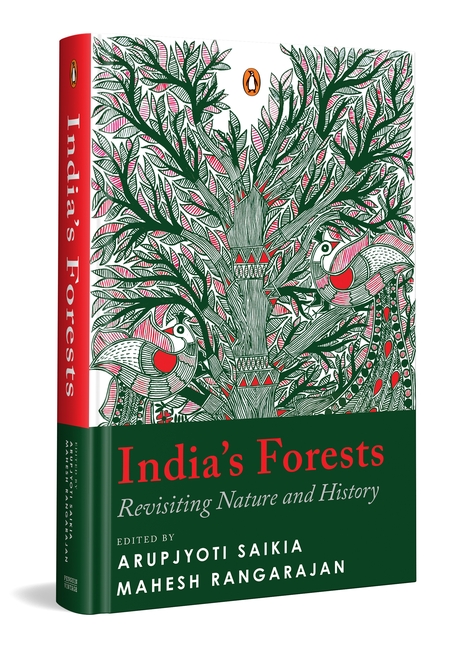
For those concerned about the state of our forests, their deterioration from dense jungles, with forest communities living in harmony with nature, to being exploited and decimated for economic gains as India moved into the industrial era, the book India’s Forests: Revisiting Nature and History, edited by Arupjyoti Saikia and Mahesh Rangarajan, is a must read.
The eleven scholars who have contributed to the book are professors, authors and field experts who provide insights into various aspects of India’s forests across different regions, including two who have based their essays on archaeological findings and what the Arthashastra had to say. There are studies of the western Himalayan foothills and central Indian highlands, Rajasthan and Jharkhand as well as the Deccan and Western Ghats. This book takes further the discussions on colonial and post-colonial forestry portrayed by Ramchandra Guha’s The Unquiet Woods, published in 1989, as well as Mahesh Rangarajan and K. Sivaramakrishnan’s books Fencing the Forest: Conservation and Ecological Change in India’s Central Provinces 1860-1914 and Modern Forests: Statemaking and Environmental Change in Colonial Eastern India.
Shekhar Pathak, historian and author of the book The Chipko Movement, in his foreword sets the tone for the book, considering “forests as green glaciers and diverse lands”. “Oxygen, water and food are essential for the survival of life forms and forests are connected with both directly and indirectly. India’s deities as well as characters from our myths, our ancestors and community memories dwell in our forests,” he states.
 The Himalayan forests determine the well-being of the entire northern plains of the subcontinent. So do the other forests of India, stretching from the central Indian forests to the central and western parts and from the Western Ghats to the coastal regions. Saving the forests means saving the soil along with the civilisation it nurtured. Chipko and other such movements were primarily about balancing the use and conservation of nature, making the difference between need and greed. Communities have always opposed the overexploitation of nature and sacred groves are one form of this expression. This is detailed in Mukul Sharma’s chapter ‘God of the first class: Politics of Sacred Groves and the Sarna in Jharkhand’.
Despite protests against feudal, colonial, post-colonial and global corporations encroaching on people’s rights on forests and commons, the focus continues to be on economic gains by exploitation of natural resources. Pathak’s concern is about the blindness to the difference between renewable and non-renewable resources. The age-old culture of peasant-pastoral wisdom is being eroded, he warns.
Population pressure on the Indian landscape has grown over the centuries. Shibani Bose writes of long-distance procurement of deodar wood from the Himalayas to third millennium BCE sites in Harappa, and bhojpatra to Allahabad district in the Ganga river basin between 10th and 8th centuries BCE. India was blessed with luxuriant forests as well as an abundance of wildlife. The tension with megafauna — a tiger mauling a man — was depicted in the rock art of Chibbar Nullah in Mandsaur, now Madhya Pradesh. The long distance movement of forest products and clashes with large wild mammals were also a feature of those early years and are depicted in the book.
Kumkum Roy writes about forests as depicted in the Arthashastra, whose origin dates to the 3rd century BCE. She says there were many categories of forests and forest people. There was emphasis on the control of dangerous spaces and unreliable forest dwellers. Forest spaces included gaja vana or elephant forests, a strategically vital resource, and the mriga vana or deer forests. The mriga vanas were areas of pleasure and those harming deer were given the same punishment as those inciting rebellion. The forests were seen as areas of wealth and there were taxes on meat from the forests as well as trees and animal products like horns, hides, tusks and skins. Forests were important and the support of forest dwellers was sought against internal and external enemies.
Meera Anna Oommen and Kathleen Morrison’s chapter, ‘Famines, Flagships and Floods’, makes interesting reading on Central Travancore’s eastern forest frontier. Even 2000 years ago, the spices of Kerala — pepper, cardamom, honey, ivory, aromatic woods, gums and resin — were in demand in Iran, Egypt and Rome. The sack of Rome (410 CE) by the Visigoth king Alaric I saw the Romans hand over a huge ransom that included 3000 pounds of pepper.
he three major powers in Southern India — the Cerar, Pantiyar and Colar — controlled large trade through ports but Velir or hill chiefs controlled the rich forest tracks in the middle and higher elevations. There are references to the elephant-and-pepper-filled forests of Ay controlled by the chiefs of the Ay kingdom. The ‘War on the Pepper Coast’ makes interesting reading of the increasing integration of India’s coastal trade into the world economy between 1400-1700 with Vasco da Gama landing in Calicut. As European pepper consumption doubled, the use of products like ginger and cardamom also increased.
Mayank Kumar’s chapter ‘Forests and Communities — Negotiations of Early Modern Monsoon Ecologies in India’ reflects on British colonial policies, largely responsible for the damage to the environment, especially flora and fauna. In pre-modern societies the local communities largely lived in harmony with nature. “Expansion of agrarian landscapes was mostly at the expense of forests, grasslands and the erstwhile tribal settlements. Till early modern period, forests remained integral to the social life of the agricultural communities and even the elite,” he writes. Other engagements with forests included the live capture of elephants, and the hunting of lions, cheetahs and caracals. But forests were not places of wild animals alone. There was an intricate strategic and political economy of horse trade, culture, breeding and upkeep.
Much like political parties today move their members to hotels to prevent them from being poached by opposing parties, in early modern times, around the 17th century, political power kept vigil over forests not only for their resources but because they sheltered recalcitrant elements of the empire. Like political and military boundaries, the forest line was constantly changing but “India was a land with islands of cultivation in a sea of forests”.
I enjoyed reading wildlife expert and conservationist Divyabhanusinh Chavda’s chapter on ‘The Lion and the Unicorn: Fighting for Survival’. For Chavda, the unicorn was a mythical equid that may have evolved out of an inaccurate description of the greater one-horned rhinoceros, which was endemic to the Indian subcontinent. My interest in the chapter is because both animals are confined to limited areas and there is genuine fear among wildlife lovers that if a major epidemic hits them, the lions could be wiped out from their centuries-old home in the Gir forests of Gujarat, and the one-horned rhino from their homes in Assam, which harbours their largest population, along with smaller numbers in Dudhwa in Uttar Pradesh and Bengal. Nepal, too, has a fairly robust population of rhinos. The importance of having more homes for both species can never be overstressed.
The Asiatic lion, whose terrain once extended from the Arabian Peninsula to Iran and the Indian subcontinent, was ruthlessly hunted and is now confined to areas around Gir. Fortunately, a few Englishmen and rulers of Gujarat’s princely states, realising that lions were getting extinct, took steps to protect them. From 284 lions in 1990, their population kept increasing, and in 2020, it was 674 individuals spread across 30,000 sq km.
The long lineage of the rhinos can be gauged from the 40 rhino seals found at the various sites of Harappa. Greek travellers reported ‘unicorns’ from 300 BCE onwards. Kumargupta in the fourth century struck gold coins to record his prowess in hunting rhinos. Babur and Jahangir also hunted rhinos. The British in 1860 also listed it as one of their sports. Between 1871 and 1907, Maharaja Nripendra Narain Bhup Bahadur shot 207 rhinos, 365 tigers and 311 leopards. Between 1908 and 1916, Kaziranga was declared a reserve forest and sanctuary for the rhinos. It was only in 1954 when rhino numbers in India and Nepal were down to 600 that Prime Minister Jawaharlal Nehru was informed of their critical state. Due to various steps taken in 2022, the rhino population increased to 3270 across 2,483 sq km of India. In 2021, Nepal had 752 rhinos across 2,704 sq kms.
Politics is once again casting shadows on the survival of these megafauna. With regional pride or asmita, Gujarat and Assam are blocking more homes for them in other states. Geneticist Stephen J. O’Brien has recorded signs of inbreeding, like reduced manes, pronounced belly folds and reduction in sperm counts in the lion population of Gujarat. Though Assam has refused to share its gainda (rhino), it is hoped some will be available from Nepal.
There was hope that sacred groves, the small pockets of forests moored in religious traditions and tribal culture, would remain undisturbed as pockets of biodiversity. Based on field work in Jharkhand, Mukul Sharma points out many sacred groves have few trees and limited ecological value. Influenced by multiple religions, the tribal religion Sarna has undergone a sea change and many sacred groves reflect the prevailing hierarchies on gender and caste. However, despite the ongoing conflicts and political dynamics, sacred groves continue to be important and need to be preserved.
Despite all the ups and downs that our forests have been through, they continue to be central to our existence. Though alternative sources of energy have been found and dependence on forest-based resources reduced, their ecological role remains. As natural carbon sinks in an era of climate change, the importance of forests can only grow.
Book: India’s Forests: Revisiting Nature and History; Edited by: Arupjyoti Saikia and Mahesh Rangarajan; Publisher: Penguin Random House India; Pages: 260; Price: Rs 999
(The article was first published in Mongabay India)