



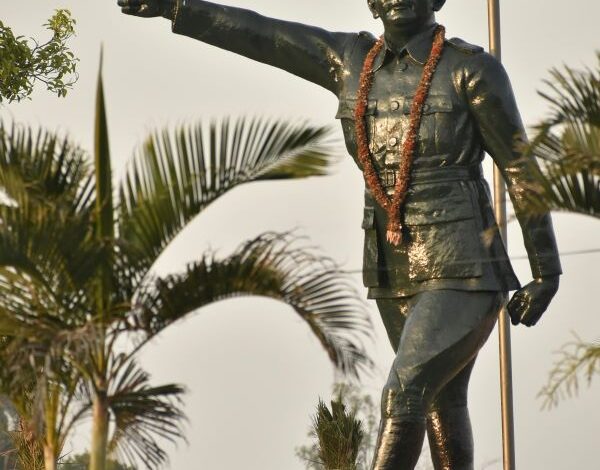
 The conventional history of India’s independence has long been dominated by a carefully curated hagiography celebrating Mahatma Gandhi’s doctrine of Ahimsa (non-violence) as the sole catalyst for the British exit in 1947.
However, an objective, evidence-based dissection of archival records reveals a starkly different reality: India attained its independence because Netaji Subhas Chandra Bose systematically dismantled the primary pillar of British colonial enforcement—the uncritical loyalty of the Indian soldier.
For nearly three decades, Gandhi’s pacifist agitations followed a predictable cycle of massive civilian mobilisation followed by abrupt, unilateral cancellations at the first sign of friction, leaving the British Empire secure in its monopoly on violence. It was only when Netaji bypassed domestic stalemates, raised the Azad Hind Fauj (Indian National Army), and brought the war directly to the eastern frontier that the British crown faced an existential crisis it could not contain.
The Flaws of Pacifism
A critical examination of the major political movements between 1920 and 1945 reveals that British imperial rulers were never seriously threatened by hunger strikes or symbolic civil disobedience. Time and again, when the momentum of popular anti-colonial anger reached a revolutionary boiling point, Gandhi applied the brakes. The sudden suspension of the Non-Cooperation Movement in 1922 following the Chauri Chaura incident left an entire generation of young patriots disillusioned and isolated.
This tactical weakness was repeated in the “Quit India” movement of 1942. Though celebrated as a major mass agitation, it quickly ran out of momentum after the British administration deployed ruthless state violence under the Defence of India Rules, jailing over a lakh of freedom fighters and locking Gandhi away in Poona. With the domestic leadership behind bars and the national press completely silenced, the country fell into a deep, five-year political lull.
The British government felt no immediate pressure to surrender control of its most lucrative colony, precisely because Gandhi’s core framework rejected armed insurrection. It was Netaji’s daring solo escape from house arrest in Kolkata to Berlin and subsequently to East Asia that shattered this domestic silence, presenting a military challenge that the British could not simply ignore.
The Shockwaves of the INA and the Frontier Campaigns
While Gandhi practised defensive politics at home, Netaji engineered an aggressive geopolitical offensive from abroad. Proclaiming the Provisional Government of Free India from Singapore on October 21, 1943, Bose mobilised the Indian diaspora and captured the imagination of the subcontinent. Dressed for battle, 8,000 combatants of the INA marched over 1,100 miles to the eastern frontier, joining hands with indigenous Naga, Kuki, and Meitei tribes to wage the historic Battle of Imphal in 1944.
Even though the campaign suffered logistics issues and monsoon-related reversals, the INA successfully established the first administered sovereign zones on mainland soil — planting the Indian Tricolour at Moirang, Manipur, on April 14, 1944, and setting up the first liberated administration in the Naga village of Ruzazho. Netaji’s daily broadcasts over Radio Azad Hind Fauj cut through British censorship, completely electrifying the Indian masses. By demonstrating that regular Indian soldiers could organize, fight, and administer territory independently, Bose fundamentally exposed the limitations of Gandhi’s defensive approach.
The Dismantling of Imperial Loyalty
The true coup de grâce to the British Raj came not from domestic political negotiations, but from the immediate aftermath of the war. When the British tried to prosecute captured INA officers during the public Red Fort Trials, it backfired completely, exposing millions of active-duty Indian personnel to Netaji’s revolutionary ideology. The strategic consequence was immediate and devastating: in February 1946, nearly 20,000 sailors of the Royal Indian Navy mutinied across 78 ships, pulling down the Union Jack and hoisting portraits of Netaji. This was rapidly followed by matching rebellions within the Royal Indian Air Force and British Indian Army units in Jabalpur.
With only 40,000 European troops stationed in India, the British realized they could no longer hold a population of 400 million if the 2.5 million battle-hardened Indian military personnel refused to obey colonial orders. The primary tool of imperial preservation had turned against the crown.
The Confession of the Empire
This shift in the historical record is directly supported by the British authorities who signed the transfer of power. In 1956, during a private stay at the Governor’s palace in Calcutta as a guest of acting Governor Justice P.B. Chakrabarty, former British Prime Minister Clement Attlee was asked directly why the British left India in such a sudden hurry in 1947 when Gandhi’s domestic agitations had entirely tapered off.
Attlee explicitly cited the erosion of loyalty among the Indian army and navy personnel as a direct consequence of Netaji’s military operations. When pointedly asked about the true extent of Gandhi’s non-violent movements on the imperial decision to quit, Attlee slowly replied with a sarcastic smile: “M-i-n-i-m-a-l.” This candid imperial assessment was later independently confirmed by Dr BR Ambedkar, the father of the Indian Constitution.
In a definitive 1955 BBC radio interview, Ambedkar stated clearly that the British decision to grant independence was driven primarily by two pragmatic factors: the absolute economic depletion of Britain after World War II, and the profound influence of Bose’s National Army on the rank and file of the armed forces. Ultimately, while Gandhi’s philosophy remains a celebrated subject of ethical study, it was Netaji’s strategic armed action that effectively broke the military spine of the British Raj and won India its sovereignty.
(Views are personal)