


Transforming teaching for adolescent health, well-being and gender equality
Comprehensive sexuality education will enable youths to make safe and confident choices about their lives

 Having taught Physics for over 30 years to young girls, when experts called for transforming teachers and teaching for young people’s health, well-being and gender equality, it resonated strongly with me.
Before the world’s largest gathering on sexual and reproductive health, rights and justice (International Conference on Family Planning or ICFP 2025) opens next week in Colombia, several experts are underpinning the importance of transforming teachers and teaching for adolescent health, well-being, gender equality and human right to health.
“Every child, adolescent and young person, regardless of who they are and where they live, deserves an opportunity to learn and develop skills that will enable them to make safe and confident choices about their lives – and comprehensive sexuality education is one such life skill,” said Sai Jyothirmai Racherla, Deputy Executive Director, The Asian-Pacific Resource & Research Centre for Women (ARROW).
Provide CSE within the education ecosystem
“Though comprehensive sexuality education is such a taboo, it is an important aspect of children, adolescents and young people’s well-being. However, we have so many barriers in advancing comprehensive sexuality education. As SRHRJ (sexual and reproductive health, rights and justice) advocates, one of our key agenda has been to ensure that we provide access to comprehensive sexuality education within the education ecosystem,” added Sai.
ARROW and partners had organised an important Asia Pacific regional multistakeholder technical meeting, which put teachers and teaching centre-stage as they deliberated on comprehensive sexuality education and broader SRHRJ.
Teachers can be good enablers to provide CSE
Just providing comprehensive sexuality education not only improves life skills but also improves the learning capabilities across other learning arenas.
Teachers and teaching and young people remained central to SRHRJ agenda of this meet, organised by ARROW, UNESCO South-East Asia, UNESCO South Asia, UNICEF East Asia Pacific, UNICEF South Asia, UNFPA Asia-Pacific and Education International Asia-Pacific in collaboration with SDG for Youth Student Network and Y-PEER Asia-Pacific Centre.
Over 160 people took part. So many ministries of education officials coming together to advance adolescent health and well-being was in itself a big milestone, said Sai.
“This meeting also furthered the agenda of gender transformative education,” said Sai. “Whole school and gender transformative approaches should connect curricula, learning environment and well-being. A whole school approach and a gender transformative approach must be included in teachers’ training too.”
Teacher class action research
One of the other recommendations that came out of this process was teacher action research. So, within the classroom practices, there is a need to enable teacher class action research so that classroom practices and the pedagogy can be improved, and it can be more resilient to meet the needs of students seeking such education.
“There was also focus on how we measured teaching and learning of comprehensive sexuality education within education systems and the data that needs to be collected at scale across the systems,” said Sai.
Youth voices echo in unison for CSE
“Beijing+30 are not only reflections and past commitments, but it is a call to action for the future. From the Asia Pacific regional multistakeholder dialogue on comprehensive sexuality education, youth voice echoed clearly that we need comprehensive sexuality education that is inclusive, right-spaced and adaptable to our diverse realities,” said Zuzan, Y-PEER Laos and Y-PEER Asia Pacific Centre.
“Even today, many young people still face stigma, lack of access and misinformation when it comes to sexual and reproductive health. So, without addressing these barriers, SDG-3 and SDG-5, will remain out of reach,” added Zuzan.
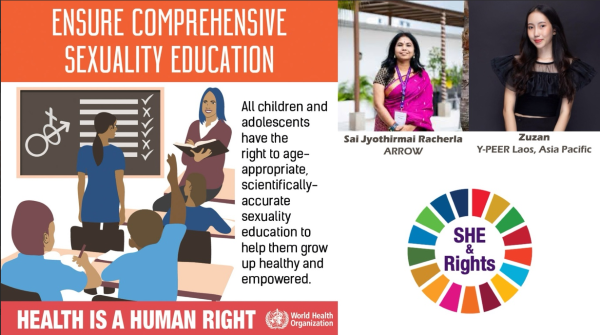
Zuzan and Sai were keynote speakers at SHE & Rights (Sexual Health with Equity & Rights) session held ahead of the International Conference on Family Planning.
INSIGHTS: HIV IN MEGHALAYA