


 Every November 14, India celebrates Children’s Day — a day of promise and celebration, when schools organise events, distribute gifts and highlight the potential of its youngest citizens. Yet, in one corner of Indore in Madhya Pradesh, a different reality plays out.
In the ‘Chaddar Factory’ basti — a slum settlement inhabited largely by the Barela and Bhil tribal communities from Nimad and Malwa — many children live with responsibilities far heavier than schoolbags.
Childhood lost
Nine-year-old Roshni (her exact age uncertain, as her parents may not even know) has never attended school. At home, her days are measured not in classes, but in chores: she helps her mother knead dough, cradles her infant sister (their fifth) on her lap, and shoulders the burden of sibling care. Her older sister, Lakshmi, once went to a tribal hostel in Khargone district, but was called back to help at home. When her fourth sister came along, Roshni became “mother” to her. And when the fifth arrived, her load grew yet again.
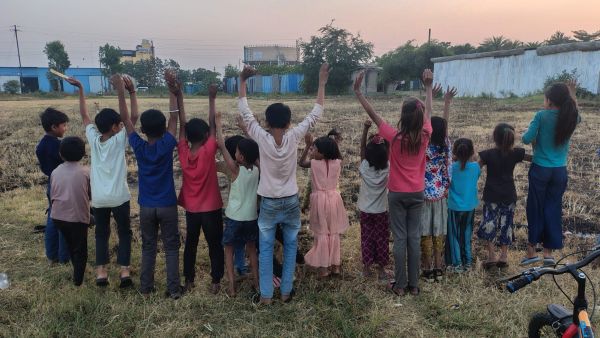
Outside, children of the basti race around open grounds, but Roshni stands apart — sometimes watching, joining in with Khushi, her little sister. Despite everything, she has started teaching herself to read: a friend’s phone here, a classmate’s notebook there. She can speak basic English and Hindi alphabets and numbers, and she dreams of going to a tribal hostel — perhaps after the next agricultural season — so she can study formally.
Her ambition is simple but profound: “I want to be a doctor,” she says, “so I can help people who need it.” When asked what she wants this Children’s Day, she replies shyly, “A doll.” She loves to sing and dance whenever she finds a moment.
But Roshni is not alone. In her settlement, most girls either stop after middle school or never enter school at all. Many lack even basic identity documents: without Aadhaar cards, they cannot enrol in Anganwadis or government schools.
Hope amid despair
Indeed, access to education remains a critical challenge for tribal children in Madhya Pradesh. Scheduled Tribes make up a significant share of the state’s population — about 20.3%, according to a World Bank–sponsored project analysis. Yet their literacy levels lag: tribal literacy in MP was just 50.55% in 2011, with a sharp gender gap — 59.5% for men, 41.5% for women.
Moreover, dropout rates among tribal girls are staggering: studies show that in Madhya Pradesh, 6.15% of tribal girls drop out between Class I–V, 8.36% between VI–VIII, and a shocking 30.51% in Class IX–X. These rates exceed their non-tribal peers in several stages, reflecting systemic neglect.
Compounding the issue is the health crisis: tribal-dominated districts in MP are among the worst for child malnutrition. As of January 2024, more than 1.36 lakh children were registered as malnourished, with nearly 30,000 classified as severely acute malnutrition, according to media reports. Areas like Khargone and Barwani — home to many Bhil families — are among the worst hit.
Still, there are glimmers of hope. The Madhya Pradesh government has invested heavily in tribal education: over Rs 60 crore has been allocated to operate 82 girl education campuses in tribal areas, and more hostels and residential schools are under construction. For instance, Mandla district, a tribal hub, has achieved 100% literacy, thanks to a grassroots ‘Niraksharta Se Azadi Abhiyaan’ (Freedom from Illiteracy) campaign launched in 2020.
Dreams are alive
Back in the basti, cousins Kavita and Ravita, who migrated from Barwani, are preparing for the NEET medical exam. Their dreams mirror Roshni’s: to become doctors and serve their community. Their perseverance — in the face of deep structural barriers — reflects a fierce determination to claim a place in a world that often seems stacked against them.
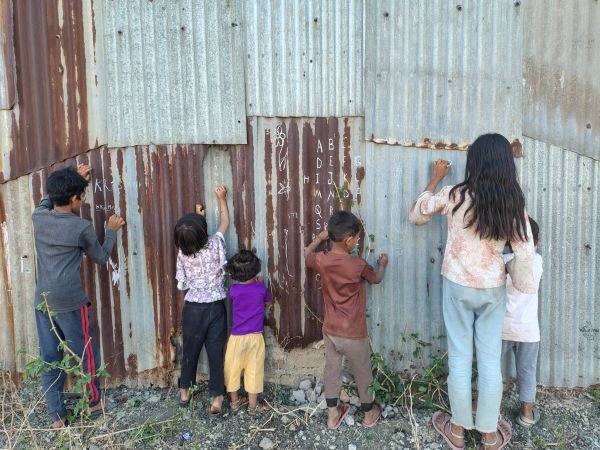
In the settlement, life is simple. Houses in Roshni’s part are made of tin or mud; there’s a shared toilet used by over 15 families. Children’s toys are nothing but discarded tyres, stones, mud and foam from a nearby glass factory. But in their play, they draw chalk-drawn blackboards on tin walls, build imaginary homes, and bat plastic bottles for cricket. Their laughter rings out — unsilenced, hopeful.
When I asked 7-year-old Chiku what he wants to be when he grows up, he stood tall and said, “A soldier!” I smiled — and said, “Amen.”