

Farmers revive tung plantations in Mizoram
However, experts caution monoculture plantations on fragile slopes risk erosion and biodiversity loss, instead recommending agroforestry-based integrated farming systems

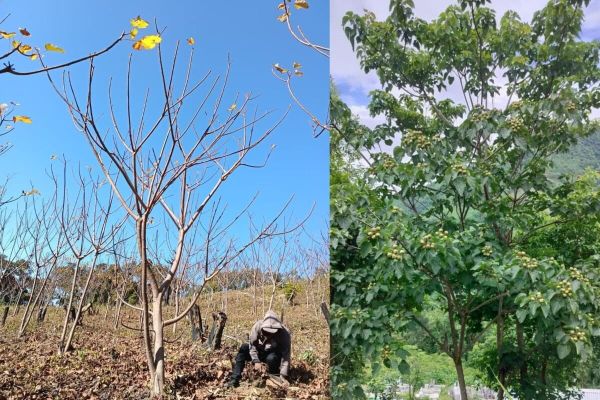
In 2023, farmers in Mizoram’s Saitual district came together to form the Saitual District Tung Grower Association to streamline the cultivation and post-harvest marketing of a tree-borne oilseed from the tung tree, which has significant industrial applications and commercial potential. What began as a small collective has since expanded rapidly. Today, more than 600 farmers across the district have joined the association, hoping to build a viable economic future around a crop that remains largely unfamiliar to most of India.
Farmers are now converting several hectares of land to cultivate the tung tree, primarily Vernicia fordii and Vernicia montana, two closely related species whose seeds yield tung oil, a non-edible but highly valuable drying oil.
However, experts caution the risks of expanding monoculture plantations on the fragile slopes in the mountain state.
Tung oil and its industrial applications
Tung oil is primarily extracted from V. fordii, with oil from V. montana occasionally blended in limited proportions.
Under favourable conditions, tung trees begin yielding fruit from the third year, though most assessments place the first reliable harvest at around the fifth year. The trees typically remain productive for 24 years, reaching peak yields between 10 and 12 years of age. Tung oil yields generally range from 300 to 450 kilograms per hectare, with the seed containing about 30-40% oil.
The oil has been historically used in products from caulk to insulating compounds. Renowned for its capacity to harden into a tough, water-resistant film upon exposure to air, it is widely used in paints, varnishes, sealants, linoleum, oilcloth, printing inks and wood finishes, and in specialised industrial applications that demand strong adhesion and durability. More recently, tung oil has been explored as a potential non-edible feedstock for biodiesel production.
The Mizoram Trade and Commerce Department cites findings from the Oil Technological Research Institute (OTRI), stating that prospects for tung cultivation in the state are more favourable than in many other regions due to the climate. Evaluations by the Central Food Technological Research Institute (CFTRI) found the oil content and physio-chemical characteristics of Mizoram-grown tung to be satisfactory.
During 2000-01, Mizoram sold 24 metric tonnes (MT) of tung oil at ₹50 per kg, extracted from 120 MT of seeds. In 2001-02, about 25 MT of oil was processed; however, it could not be sold at remunerative prices due to cheaper imports from China.
A growing demand for tung oil
Tung plantation may be gaining attention in recent years, but it is not new to Mizoram.
“In 1992, I cultivated about ten acres (around four hectares) of tung,” said sexagenarian Zairemthanga, President of the Saitual District Tung Grower Association. “The agriculture department supplied the seeds, and we cleared forest land for plantation. But when the trees began yielding after three to five years, the price was extremely low, around ₹5 per kg. We were told the seeds would be marketed, but that never happened, even though production was good.”
“After a few years, most farmers cleared nearly 70-80% of their plantations to cultivate other crops,” he added. “With the renewed push for tung, I revived five acres (around two hectares) in 2023. The new trees are yet to bear seeds, but I sold a quintal from the older ones for ₹55 per kg in 2025-26. This time, I am hopeful the outcome will be different, because market connectivity is far better than it was in the 1990s.”
R. Lalramhluni, Joint Director of Mizoram’s agriculture department, also added that in the early 1990s tung cultivation was taken up on a large scale. ”It was an important component of the state government’s flagship New Land Use Policy (NLUP). Mizoram’s climate, rainfall patterns and elevation suited the tree well. However, poor market linkages, the absence of processing facilities and a lack of entrepreneurial support meant that neither the seeds nor the oil could be sold,” she added. Over time, a tree once seen as valuable came to be referred to locally as a ‘dooms tree’.
In Mizoram, tung was popularised under the NLUP (1991–1997) and over seven million trees were recorded across nearly 7,785 hectares during that period.
Lalramhluni said that Mizoram’s government has been working to transition away from traditional shifting cultivation, a practice associated with forest clearing, soil degradation and heightened fire risk. Policymakers have emphasised the need to strengthen economically viable, market-linked crops to enhance long-term stability.
Against this backdrop, and amid growing demand for tung oil in India, the state has renewed its push for tung plantations, positioning the tree-borne oilseed as a potential alternative. “The initiative is being implemented under the National Mission on Edible Oils- Oilseeds (NMEO-OS), 2024, which also focuses on Tree-Borne Oilseeds (TBOs). Each grower receives one kg (of seeds for plantation per acre, along with monetary support (₹8,000 per acre). We have procured 50 quintals of seeds from Saitual for distribution (across the state), for the March-April, 2026 sowing season,” she added.
Revival and intercropping
In 2023, when a tung oil processing company in the Serchhip district offered better market access and improved prices, Robert Lalnuntluanga, a grower from Saitual, was one of the many people who restored their earlier tung plantation that they cleared. “Although tung is not native to Mizoram, over the years we have not observed any damage to the soil or signs of it becoming invasive from the few trees that remained,” he said. “It is possible to practise intercropping, particularly with shade-loving crops, as the tree can grow up to 20 metres. We are attempting to cultivate coffee. Some farmers have been able to grow turmeric and betel leaf successfully.”
The seeds fall between November and December. These are harvested and collected at the growers association, which supplies them to the processing plant in Serchhip. While the newly planted trees are yet to bear fruit, growers in Saitual have collectively sold around 20 MT in 2025-26 from the older trees.
“The Agriculture Department has provided ₹8,000 per acre for weeding and upkeep of the older plantations. Along with officials, we are regularly visiting villages to promote tung. We have also submitted a proposal to the Planning and Programme Implementation Department for setting up a processing unit in Saitual,” informed V. Lalhruaitluanga, an adviser to the association.
Lalramhluni added, “We began promoting tung in 2024 in the Serchhip and Khawzawl districts, and the response from farmers has been encouraging. In 2026, we plan to cover around 1,000 hectares across eight of the state’s eleven districts. The three western belt districts — Mamit, Kolasib and Lawngtlai, are not included, as their low-lying terrain is considered more suitable for oil palm cultivation.”
Developing self-reliance, reducing imports
India’s current annual requirement for tung oil is around 400-500 MT, said Himanshu Bansal the founder of M/s Vorya Enterprises (tung oil manufacturing unit) and the director of Finmor Corporate Communications Pvt. Ltd. (importer). “Domestic production is negligible, so most of it is imported from China, which controls over 95% of the global market.” Prices range between USD $2,500 and $4,000 per tonne, depending on annual output and market demand, he added. “From a pricing perspective, it is currently more viable to import. However, we are promoting plantations in India so that, over time, we can match Chinese price levels while ensuring farmers receive a stable income. Tung trees can provide returns for up to 30 years after initial establishment support. Expanding cultivation can also help reduce carbon footprints by increasing tree cover.”
The global market for tung oil is relatively niche compared with major vegetable oils, but it is steadily expanding. According to market research sources, the global market was valued at around $223 million in 2025 and is expected to grow to approximately $283 million by 2034.
“My father, Pu Rualzakhuma, established a processing plant in 1994. However, there were no clear guidelines or marketing support. Our family had about 30 hectares under plantation. Although the broader initiative eventually declined, we continued to extract tung oil each year using whatever seeds we could source from farmers,” said Lalhmachhuana, the general manager of RZ Foundation, Mizoram’s only tung oil processing plant in Serchhip. Without dedicated tung oil processing machinery available in India, they use conventional seed oil expellers, which are modified for tung oil extraction.
“To produce one kilogram of tung oil, we require about six to seven kilograms of seeds, depending on quality. Our plant can process 20-30 quintals of seeds per day. In recent years, we have sold around 5,000-6,000 kg of oil annually at ₹350-400 per kg to companies outside the state. And the residual oil cake can be used as fertiliser,” Rualzakhuma added.
“However, trees planted in the 1990s are now aging and yields have declined. Since we secured a better market in 2022, the RZ Foundation launched a five-year project (2022-2026) to promote new plantations across the state; backed by the Agriculture Department from 2024.”
Since 2022, around 3,000 households from nearly 250 villages across the state have taken up tung cultivation, and the number is only increasing, said Lalhmachhuana. The foundation has developed plantation guidelines based on their years of experience and research, and supplying seeds for planting at ₹200 per kg. The harvest from these new plants is expected to begin around November-December 2026.
“We are planning to procure larger equipment that can scale capacity to at least 100 quintals a day. However, India still does not have dedicated machinery for tung oil processing, so we have to customise the equipment to suit our needs,” stated Lalhmachhuana.
Risks with expanding plantations of non-native species
The detailed project report for tung cultivation submitted by RZ Foundation cautions that given Mizoram’s fragile hilly terrain and existing land-use practices, large-scale tung plantations could intensify ecological pressures if not carefully planned, including potential impacts on local biodiversity and the risk of the species becoming invasive. It emphasises the need for sustainable plantation management through prudent site selection, soil and slope protection, intercropping, and active community involvement to ensure environmental safeguards alongside long-term livelihood security.
“Mizoram’s slopes are susceptible to erosion, dominated by Muli bamboo, with insufficient mother trees and diverse indigenous vegetation. Shortened jhum fallow cycles have weakened natural regeneration,” says Samir Bordoloi, Founder of Green Commandos Forum and Agricultural Extension Specialist with FAO India’s (Food and Agriculture Organization of the UN) Green-Ag project in Mizoram. “Replacing jhum with large-scale monoculture plantations of non-native species for financial security is not the answer. We’ve already seen the ecological damage from oil palm. Such models further degrade soil and destabilise fragile hill ecosystems.”
Instead, he points to the FAO-supported Mizoram Sloping Agriculture Land Technology (MiSALT), which integrates the indigenous ‘changkham’ practice of laying half-burnt logs and crop residues along slopes to slow runoff, with Sloping Agriculture Land Technology (SALT), where nitrogen-fixing trees are planted along contours to control erosion. The model also promotes ‘Very Important Plants’ (VIPs) which are indigenous species for food and fodder.
“Mizoram’s future lies in agroforestry-based integrated farming built on agroecological practices and native perennial crops that provide food, medicine, fodder and biomass. Canopy trees are crucial for stabilising and rebuilding soil. Such diversification can strengthen agrobiodiversity and ease pressure on forests, sustaining hill agriculture both economically and ecologically,” he argued.
Abhinandan Saikia, an assistant professor and the Associate Dean at the School of Social Sciences and Humanities, Tata Institute of Social Sciences (Guwahati Campus), also warns that even if a species is currently classified as non-invasive does not preclude the possibility of it exhibiting invasive tendencies in the future. “Biological invasions are typically lag-phase phenomena; ecological impacts may become apparent only after several decades. By that time, the species may have established complex trophic and symbiotic relationships with native flora and fauna, including soil microbiota. At that stage, attempts at removal can trigger secondary ecological disturbances, sometimes causing more disruption than the species itself,” he said.
Saikia recommends that the introduction or reintroduction of a species be implemented at a pilot scale under controlled conditions. “Gradual and selective expansion, based on rigorous ecological assessment, is essential to reduce uncertainty and unintended consequences,” he concluded.
(The article was first published in Mongabay)