

Dr D. Jeevan Kumar
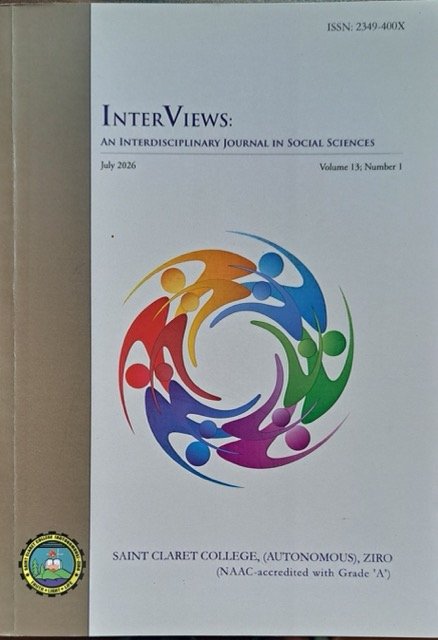
The July 2026 issue of InterViews—Volume 13, Number 1—published by Saint Claret College (Autonomous), Ziro in Arunachal Pradesh contains seven research articles and one book review. Its subjects range from university regulation and social work education to language, disaster preparedness, employment and community health. Several contributions focus directly on North East India; others connect regional concerns with national institutions and international scholarship.
The strongest thematic connection concerns whose knowledge receives recognition and whose voice influences institutions. A broader connection concerns whether education, healthcare and development respond adequately to the people they serve. These two strands allow a coherent review while respecting the differences between the contributions.
 Across its varied subjects, a recurring question emerges: how adequately do established institutions and dominant frameworks recognise the knowledge, experiences and needs of communities situated beyond centres of authority?
This question connects the issue’s discussions of indigenous knowledge, linguistic identity and gender with its examinations of higher education, unemployment and health. The connections are strongest when treated as an invitation to read the papers together, rather than as evidence that all their authors share an identical intellectual position.
Juster Lyngdoh’s article on colonial realities in social work knowledge production provides the clearest conceptual starting point. It questions the authority accorded to Western frameworks in interpreting indigenous societies and examines the implications for social work education in North East India. Its concern extends beyond adding local examples to an established curriculum: it asks whether indigenous world views can help determine the questions, methods and purposes of inquiry itself.
Significantly, the argument allows for collaboration and knowledge exchange with Western scholarship, but on more equal terms. Read in this way, decolonisation becomes a demand for intellectual reciprocity and a redistribution of authority within knowledge production.
Utpal Deka’s contribution carries a related concern into disaster risk reduction. It examines how indigenous knowledge can enter formal policy frameworks through meaningful community participation. Its distinction between acknowledging traditional practices and empowering their holders is particularly valuable.
Documentation alone does not secure influence over decisions, resources or implementation. The article accordingly advocates consent, community leadership, legal safeguards and more equitable collaboration. It also acknowledges that changing climatic conditions can undermine the reliability of traditional indicators. This qualification strengthens the argument: effective cooperation between knowledge systems requires continuing evaluation as well as mutual respect.
The article by Y. Philip and Thungyani Ovung on the Lotha language adds the dimension of cultural continuity. Using Fishman’s framework, the article examines language maintenance, shifting patterns of use and intergenerational transmission.
Lotha’s position emerges as uneven across social settings: family and community use coexist with pressures associated with urbanisation, multilingualism and English-dominated education. Particularly useful is the proposition that variation can express the adaptability of a living language. The wider question for the issue is how communities can participate in contemporary education and communication while sustaining the linguistic resources through which identity and collective memory are transmitted.
Batskhem Myrboh’s examination of UGC regulations shifts attention to institutional authority within the Indian federation. The article explores tensions between national regulation and the powers of states in higher education. Yet its discussion also identifies failures by states to adopt or implement regulatory provisions. This gives the contribution a more complex significance than a straightforward defence of either level of government.
Read alongside the articles on indigenous knowledge, it raises a related institutional question: how can common standards be reconciled with dispersed authority and differing circumstances? The connection is suggestive, although federal autonomy and indigenous intellectual autonomy remain distinct concerns requiring separate analysis.
The two studies of the Nocte community bring the discussion into everyday experiences of health. Reetimoni Hazarika and Md. Asghar examine 120 elderly participants and identify substantial health needs alongside limited uptake of annual health examinations. Their recommendation for accessible geriatric care gives empirical substance to the issue’s broader concern with inclusion.
The study makes visible a population whose needs require specific attention within primary healthcare. Its findings should, however, be understood within the limits of a cross-sectional community study; they cannot automatically represent all elderly tribal populations in Arunachal Pradesh.
Rubu Anu, Dibyajyoti Das and Md. Asghar examine menstrual knowledge, attitudes and practices among 65 Nocte mother–daughter pairs. The study reports better knowledge among daughters while identifying mothers as important sources of information. This contribution introduces a productive complication into any celebration of inherited knowledge: intergenerational transmission can provide support and continuity while also carrying misconceptions.
A responsive approach to health education would, therefore, engage mothers as well as daughters, connecting trusted relationships with accurate information. The paired design is valuable for exploring generational differences, although it does not establish what caused those differences.
Hamlet B. Lyngdoh and A. W. Rani’s article on youth unemployment in Meghalaya extends the discussion to economic opportunity. It surveys policy responses involving entrepreneurship, agriculture, cultural activity and youth organisations. Its critical value lies in recognising that a proliferation of schemes cannot by itself overcome structural constraints.
The authors discuss subsidy dependence, uneven geographical reach, limited private employment and the insecurity of some emerging livelihoods. Within the proposed thematic reading, the article asks whether young people’s inclusion in programmes translates into durable opportunities. A useful next step would be evaluation of employment quality, enterprise survival and distribution of benefits, alongside programme coverage.
Sonam Sultana Shah’s review of Margaretha Geertsema-Sligh’s Journalism and Gender: Global Perspectives returns to the relationship between knowledge and power.
The review considers the limits of treating Western experiences as universal and stresses differences among women’s professional circumstances. Its distinction between numerical presence and meaningful authority resonates with the issue’s other contributions. Participation can expand while established hierarchies persist. Shah also recognises that the category “Global South” can conceal internal differences—a caution equally relevant to discussions of North East India, indigenous communities and women as collective categories.
The principal strength of the July 2026 issue of InterViews is its capacity to connect questions of recognition with material concerns. Knowledge, language and representation appear alongside healthcare, livelihoods and institutional governance. This breadth invites readers to consider how cultural respect, access to services and influence over decisions might reinforce one another.
The thematic connection also exposes a useful tension. Recognising community knowledge does not settle questions about its reliability, internal inequalities or relationship with individual rights. Equally, national standards and professional expertise require scrutiny of how they are exercised and whose circumstances they accommodate. A critical review should preserve these tensions.
The most defensible overall assessment is that the issue offers a set of connected inquiries into recognition, participation and wellbeing, with North East India providing a substantial geographical and intellectual centre. Its contributions invite a shared question: what changes when communities’ experiences become part of the basis on which knowledge is produced, institutions are governed and development is assessed?
The journal deserves commendation for a noteworthy editorial practice: Each published article clearly records its date of receipt, receipt of the revised version, acceptance and publication. Making this chronology visible enhances transparency and reflects the Editorial Board’s accountability to contributors. Regular updates during the review process further strengthen this commitment, sparing authors prolonged uncertainty about the fate of their submissions.
The journal also merits appreciation for its meticulous proofreading and the quality of its production. Its frequency of publication, however, warrants reconsideration. A transition from an annual to a twice-yearly—and, in due course, perhaps quarterly—publication would provide greater scope for timely scholarly engagement. The myriad issues concerning the North-East deserve more frequent discussion, analysis and dissemination, and the journal is well placed to provide such a forum.