


Manipur forgotten? NEC Shillong meet ends with zero action on 3-year crisis

 The 73rd Plenary Session of the North Eastern Council (NEC) in Shillong on June 4 may have been one of the most important opportunities in recent months for the Centre to demonstrate that resolving the Manipur crisis remains a national priority.
This was also an occasion to seek the collective wisdom of the chief ministers, governors and officers to address the issue. But Union Home Minister Amit Shah chose to speak on other issues leaving Manipur.
Neither the Governor nor the Manipur Chief Minister spoke to journalists about the current situation.
NEC and DoNER used to proclaim that there is no development without peace but it seems it was all hollow words.
There was no major public announcement, roadmap or initiative specifically addressing the continuing crisis in Manipur. At a time when the entire Northeast’s political leadership was gathered under one roof, many expected a stronger message that the Centre was committed to finding a lasting solution.
More than three years after ethnic violence erupted in May 2023, Manipur continues to witness periodic unrest, security incidents and tensions between communities. Thousands remain displaced, many continue to live in relief camps and large sections of the state remain divided along ethnic lines. While the intensity of violence has reduced compared to the early months of the conflict, peace remains fragile and reconciliation remains distant.
The origins of the conflict lie in longstanding tensions between the Meitei community, concentrated largely in the Imphal Valley, and the Kuki-Zo tribes residing predominantly in the hill districts. Disputes over land rights, political representation, identity, security concerns and demands relating to Scheduled Tribe status contributed to a volatile situation that eventually exploded into widespread violence in May 2023.
Now, the conflict has spread further, and the Nagas have got involved against the Kuki-Zo community.
Security forces were deployed in large numbers, curfews were imposed, internet services were suspended at different periods, relief camps were established and investigations were launched into incidents linked to the violence. Several rounds of meetings have been held between officials and community representatives.
Yet the question remains: why has peace remained elusive despite these interventions? The answer lies partly in the depth of mistrust that has developed between communities. Security measures can prevent escalation, but they cannot by themselves rebuild trust, facilitate the return of displaced families or create a political framework acceptable to all sides. Those challenges require sustained political engagement.
This is where criticism of the Centre has become most pronounced. While Shah visited Manipur during the crisis and oversaw several security and administrative measures, many in the state and beyond have questioned the level of political attention given to the issue by the country’s top leadership. Prime Minister Narendra Modi’s limited public engagement with the crisis became a recurring point of debate, particularly as the violence stretched from months into years.
Modi’s silence continues even now, even after Manipur citizens’ appeals on social media.
It is often argued that actions matter more than symbolism. A crisis of this scale required visible and sustained political leadership from the highest levels of government.
The Shillong NEC meeting brought together the people who could collectively contribute to a long-term solution — chief ministers, governors, senior bureaucrats and the Union Home Minister. It was an occasion not only to discuss roads, infrastructure and economic growth but also to seek the collective wisdom of the Northeast’s leadership on how to restore lasting peace in Manipur. Instead, the issue remained largely absent from the public narrative surrounding the meeting.
It seemed as if there was an embargo on the subject of Manipur violence.
The lesson from Manipur is one that Northeast leaders themselves have often repeated over the decades: there can be no development without peace. Infrastructure projects, investments and economic initiatives are important, but they cannot substitute for reconciliation, political dialogue and trust-building.
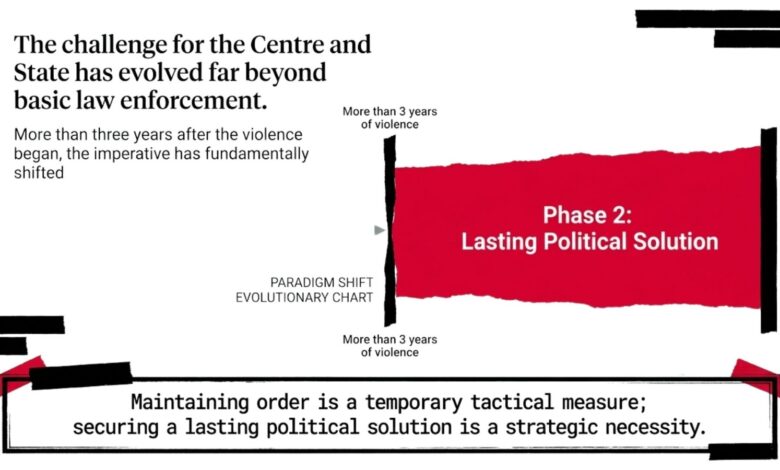
More than three years after the violence began, the challenge before both the state government and the Centre is no longer simply maintaining order. It is demonstrating that a lasting political solution for Manipur remains an urgent national priority rather than an unresolved crisis pushed to the margins of public attention.